
What Is an EOS® Integrator?
An EOS® Integrator™ is the second-in-command in a company running on the Entrepreneurial Operating System® (EOS®). While the Visionary sets the direction, the Integrator turns that vision into execution by leading the leadership team, aligning departments, resolving issues, and holding people accountable for results.
For many growing businesses, the challenge isn’t a lack of ideas. It’s finding the leadership capacity to execute those ideas without requiring the Visionary to manage every decision.
That’s where an Integrator comes in.
In this guide, we’ll explain what an Integrator does, how the role differs from a Visionary, COO, and EOS Implementer, when your business may need one, what makes a great Integrator, and how to hire the right person.
What Does an EOS® Integrator Do?
An Integrator is the executive responsible for coordinating execution across the business. Working alongside the Visionary, the Integrator translates the company’s direction into priorities, decisions, and measurable results.
The role extends beyond overseeing daily operations. An effective Integrator connects departments, manages competing priorities, and ensures the leadership team works toward the same goals.
- Leading the leadership team: Aligning leaders around company priorities and expectations.
- Driving execution: Turning the company's vision and quarterly priorities into action.
- Maintaining accountability: Ensuring leaders own their commitments, including their Rocks and measurable goals.
- Resolving cross-functional issues: Addressing conflicts and removing obstacles between departments.
- Managing daily operations: Keeping the business running effectively and consistently.
- Reinforcing EOS practices: Supporting the company's meeting rhythms, Scorecards, issue-solving process, and other EOS tools.
- Making decisions: Exercising the authority needed to resolve disagreements and keep the business moving.
Visionary vs. Integrator: Understanding the Two Leadership Roles
The Visionary and Integrator are complementary leadership roles. Both contribute to the company’s success, but they focus on different aspects of running the business.
| Responsibility | Visionary | Integrator |
|---|---|---|
| Primary focus | Vision, strategy, and future opportunities | Execution, alignment, and organizational performance |
| Core strength | Innovation and big-picture thinking | Coordination, structure, and accountability |
| Strategic contribution | Defines where the business is going | Turns the direction into action |
| Leadership focus | Inspires, challenges, and identifies opportunities | Leads the leadership team and manages execution |
| Decision-making | Sets strategic direction and contributes ideas | Makes operational decisions within agreed authority |
| Key relationships | Customers, partners, and external stakeholders | Internal leaders, departments, and teams |
| Key question | Where should we go next? | How will we get there? |
The Visionary is often the founder or CEO who sees opportunities, generates ideas, and sets the company’s direction. The Integrator brings the discipline and coordination needed to make that direction a reality.
Problems arise when one person tries to occupy both seats indefinitely.
The Visionary may become consumed by daily decisions, while the Integrator may struggle to lead if the Visionary continues to control every operational detail.
A successful partnership requires trust, clear ownership, open communication, and agreement about which decisions belong to each leader.
Learn more about why Visionaries need Integrators.
Do You Actually Need an Integrator?
Not every growing business needs a dedicated Integrator immediately. But if your company is expanding and you’re still responsible for both strategic direction and daily execution, it’s worth evaluating whether your leadership structure can support the next stage.
Here are six signs you may be operating in both seats.
1. Decisions keep coming back to you.
Your leadership team regularly asks for approval on decisions they should be able to make themselves. Even routine issues interrupt your day.
2. Important priorities keep stalling.
You have ambitious goals, but projects lose momentum. Quarterly commitments roll over, and good ideas never translate into consistent results.
3. Your leadership team lacks accountability.
People are busy, but ownership is unclear. Deadlines are missed, commitments go unaddressed, and you have to step in to keep everyone on track.
4. Departments operate independently.
Sales, operations, finance, and other functions may perform well individually, but their priorities conflict. You become the person responsible for resolving every disagreement.
5. You're still managing work you should have delegated.
Instead of focusing on strategy, growth, and key relationships, you spend your time troubleshooting, answering questions, and coordinating daily operations.
6. The business struggles when you're unavailable.
When you step away, decisions slow down and execution suffers. The company still depends on your involvement to keep things moving.
These signs don’t automatically mean you need to hire an Integrator. Sometimes the underlying issue is unclear accountability, an existing leader who lacks authority, or a leadership structure that hasn’t kept pace with growth.
The important question is: Does your business have someone with the capacity and authority to own execution across the organization?
If the answer is no, it may be time to assess whether an Integrator is the right next hire.
Not sure which leadership seat your business needs?
VisionSpark helps growth-stage businesses evaluate their leadership structure, identify gaps, and determine which roles will best support their next stage of growth.
Integrator vs. COO vs. EOS Implementer®: What's the Difference?
The titles Integrator, COO, and EOS Implementer® are often confused, but each describes a different role.
| Role | What they do | When you need one |
|---|---|---|
| EOS Integrator | Leads internal execution, aligns the leadership team, and drives accountability within an EOS company | You need a true second-in-command to turn the vision into results |
| Chief Operating Officer (COO) | Oversees operations, business performance, and execution according to the company's leadership structure | You need an executive to manage operations and help scale the business |
| EOS Implementer® | Works externally with the leadership team to teach EOS tools, facilitate sessions, and support implementation | You need guidance implementing EOS and strengthening your leadership team's use of the system |
An Integrator may hold the title of COO, President, or General Manager. The title alone doesn’t determine whether someone is functioning as the Integrator.
The key distinction is accountability. The Integrator is an internal executive responsible for driving execution. The EOS Implementer® helps the leadership team learn and apply EOS® but doesn’t replace the internal leader responsible for running the business.
Some companies need both. An EOS Implementer® can help the team establish the system, while the Integrator provides ongoing leadership and accountability.
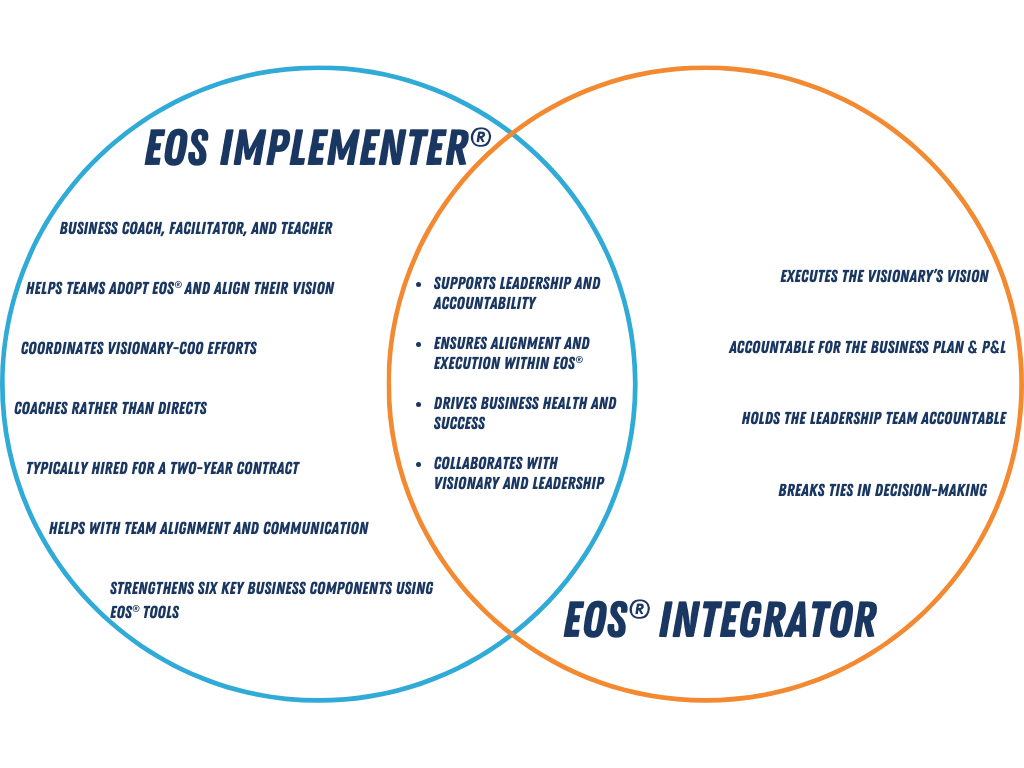
How Do an EOS Implementer® and Integrator Work Together?
An EOS Implementer® and an Integrator serve different purposes, but both can contribute to a company’s success.
An EOS Implementer®is an external professional who helps the leadership team learn, understand, and apply the EOS® model. An Integrator is an internal executive responsible for leading the team, driving execution, and maintaining accountability across the business.
Their responsibilities are different, but they share a common goal: helping the company operate more effectively.
Where they differ:
- EOS Implementer®: Facilitates EOS® sessions, coaches the leadership team, and guides the adoption of EOS® tools and practices.
- EOS Integrator: Leads daily execution, manages cross-functional issues, and holds the leadership team accountable for results.
Where they overlap:
Both support leadership alignment, organizational clarity, and consistent use of EOS® principles. The Implementer helps the team learn and apply the system, while the Integrator ensures the business follows through on its priorities.
An EOS Implementer® can also help a leadership team recognize when it needs an Integrator. However, facilitating EOS® and owning the day-to-day execution of a business are distinct responsibilities. One role does not replace the other.
What Makes a Great Integrator?
A successful Integrator needs more than operational experience. The person must be able to think strategically, lead leaders, manage conflict, make decisions, and hold people accountable.
Through its work with EOS® companies, VisionSpark has identified six important traits to evaluate when hiring an Integrator.

1. Strategic thinker
A strong Integrator understands how decisions affect the entire business. They process information quickly, anticipate challenges, recognize patterns, and make sound decisions based on facts.
2. Strong communicator
An effective Integrator communicates expectations clearly, listens carefully, navigates difficult conversations, and addresses problems directly. They can challenge people without damaging productive working relationships.
3. Process-oriented
The Integrator understands how systems, workflows, and departments connect. They identify inefficiencies, improve processes, and establish the structure needed for consistent execution.
4. People-oriented
Leading a leadership team requires emotional awareness, resilience, sound judgment, and the ability to hold people accountable. A great Integrator can withstand criticism, address underperformance, and guide people through difficult decisions.
5. Organized
An Integrator must manage competing priorities, track commitments, allocate resources, and keep the organization moving. They adapt to change without losing sight of important goals.
6. Coach
The best Integrators develop leaders rather than solving every problem themselves. They provide feedback, ask difficult questions, and help employees take greater ownership of their responsibilities.
These traits must work together. Someone can be highly organized but struggle to challenge an underperforming leader. Another candidate may communicate well but lack the judgment needed to make difficult business decisions.
That’s why hiring should evaluate the complete leadership profile, not just experience, job titles, or interview performance.
VisionSpark uses structured evaluation and its Talent Impact Profile™ (TIP™) assessment to help understand candidates’ aptitudes, behavioral tendencies, and fit with the demands of the role.
Learn more about how VisionSpark uses assessments to evaluate candidates.
Can You Promote Someone Internally to Integrator?
Yes. An existing employee or executive may be an excellent candidate for the Integrator seat. They may already understand your business, culture, customers, and leadership team.
But being a trusted employee or a strong department leader doesn’t automatically mean someone is ready to lead the entire organization.
Before promoting someone internally, evaluate four areas.
Leadership capacity. Can this person lead across departments, manage competing priorities, and make decisions beyond their current functional responsibilities?
Accountability. Are they comfortable setting expectations, addressing underperformance, and holding their peers accountable? Will other leaders accept their authority?
Strategic thinking. Can they connect daily decisions to company-wide objectives and balance immediate operational needs with long-term goals?
Future readiness. Can they grow with the business as complexity increases, the leadership team expands, and responsibilities change?
Also consider what happens to the person’s existing role. Promoting someone without redefining their previous responsibilities can leave important work uncovered or create two jobs for one person.
Use the same role-definition and evaluation process you would use for an external candidate. Identify the capabilities the business needs, assess the candidate against those requirements, and establish clear decision-making authority before making the transition.
An internal promotion can be the right answer. Familiarity with the business, however, should not replace an objective assessment of fit.
Full-Time vs. Fractional Integrator: Which Is Right for Your Business?
A fractional Integrator may provide experienced leadership without the commitment of a full-time executive. A full-time Integrator provides more consistent ownership across the business.
The right arrangement depends on the company’s needs, complexity, and leadership capacity.
| Consideration | Fractional Integrator | Full-Time Integrator |
|---|---|---|
| Time commitment | Limited, agreed-upon engagement | Dedicated executive role |
| Best fit | Developing leadership needs or a more focused scope | Ongoing, complex leadership and execution demands |
| Availability | Defined hours and responsibilities | Greater day-to-day availability |
| Cost structure | Engagement fees based on scope and time | Salary, benefits, and other executive compensation |
| Potential limitation | Limited capacity for daily decisions and ongoing issues | Higher fixed cost and greater hiring commitment |
A fractional arrangement may work when the company needs help establishing accountability, improving execution, or determining the scope of a permanent leadership role.
A full-time Integrator may be more appropriate when the leadership team needs daily direction, cross-functional decisions are constant, or the company’s complexity requires sustained executive ownership.
Neither option is automatically better. The goal is to choose the level of leadership the business requires today while considering what it will need as it grows.
Some companies transition from fractional to full-time leadership as responsibilities expand. Others may find that a fractional arrangement continues to meet their needs.
For more guidance, explore when to transition a fractional Integrator to a full-time employee.
What Does an Integrator Cost?
Integrator compensation varies based on company size, revenue, location, industry, leadership scope, and the experience required. Bonuses, profit-sharing, and equity may also influence the overall compensation package.
Before setting a salary, define the role clearly. An executive responsible for coordinating a small leadership team will have different demands from one leading multiple departments, managing complex operations, and preparing the company for significant expansion.
- The scope of responsibility and decision-making authority.
- The size and complexity of the organization.
- The candidate's leadership experience and capabilities.
- The local executive talent market.
- The company's growth plans and performance expectations.
- The mix of base salary and potential incentives.
Compensation should reflect the responsibilities of the seat, not just the title on the job description.
For salary benchmarks and more detailed guidance, read VisionSpark’s Integrator/COO Compensation Guide.
How to Hire the Right EOS Integrator
Hiring an Integrator is a high-impact leadership decision. The right person can strengthen execution, align the leadership team, and reduce the company’s dependence on the Visionary for daily decisions.
The wrong person can create friction, weaken accountability, and leave the Visionary managing the business just as before.
A strong hiring process begins with five steps.
Step 1: Define the seat before searching
Identify the business problems the Integrator must solve, the results they will own, the decisions they can make, and the responsibilities they will carry.
Avoid building the job description around a long list of tasks. Define what success looks like.
Step 2: Establish the right leadership profile
Determine the capabilities, experience, behavioral tendencies, and leadership style required for your company. Consider your stage of growth, culture, existing team, and future needs.
Step 3: Evaluate candidates beyond their résumés
Previous accomplishments matter, but they don’t tell the whole story. Use structured interviews, evidence-based questions, and appropriate assessments to evaluate judgment, communication, accountability, and leadership capacity.
Step 4: Evaluate Visionary/Integrator chemistry
The partnership requires trust, complementary strengths, clear expectations, and the ability to disagree constructively.
Assess how the Visionary and candidate communicate, make decisions, handle conflict, and share authority. Strong credentials alone don’t guarantee a successful partnership.
Step 5: Establish authority and onboarding expectations
Before the new Integrator starts, agree on responsibilities, decision rights, communication rhythms, and measures of success. Explain the Integrator’s role to the leadership team and establish the authority needed to lead.
The hire is only the beginning. The transition must give the Integrator the room to do the job.
For a more detailed walkthrough, read How to Hire an Integrator. Once you’ve made the hire, use How to Onboard a #2 Leader to establish ownership, relationships, and expectations from day one.
What Should an EOS Integrator Job Description Include?
A strong Integrator job description should explain the role’s purpose, authority, responsibilities, and expected results. It should also distinguish the Integrator from the Visionary and other functional leaders.
Role summary
Own the day-to-day execution of the business, lead the leadership team, and translate the Visionary’s direction into coordinated action and measurable results.
Core responsibilities
- Lead the leadership team’s meeting rhythm and quarterly commitments.
- Oversee business performance and the operating plan.
- Translate strategic direction into priorities, owners, and deadlines.
- Resolve issues that cross departments.
- Develop and hold leaders accountable for results.
- Improve processes and organizational alignment.
- Support a culture of clear communication and ownership.
Reporting structure
The Integrator typically reports to the Visionary or owner, with functional leaders reporting through the Integrator as defined by the company’s Accountability Chart.
What success looks like
The leadership team follows through on commitments, issues are resolved at the appropriate level, and the Visionary can devote more time to strategic direction rather than routine operational decisions.
Avoid overloading the job description with software requirements or an unrealistic list of qualifications. Focus on the judgment, accountability, leadership capacity, and organizational fit the role requires.
How VisionSpark Helps Companies Find the Right Integrator
Hiring an Integrator is not simply about finding an experienced operations executive. It’s about identifying the right person for the seat, defining the responsibilities clearly, and evaluating whether the leader can succeed in your specific business.
VisionSpark works with growth-stage companies, including businesses running on EOS, to identify leadership gaps and find candidates who fit the company’s needs.
Our approach includes:
Role definition.
We clarify the responsibilities, authority, and outcomes the Integrator must own before beginning the search.
Targeted executive search.
We identify candidates whose experience and capabilities align with the requirements of the role.
Structured candidate evaluation.
We look beyond résumés and interview impressions to assess leadership fit using structured evaluation and appropriate assessment tools, including the Talent Impact Profile™.
Visionary/ Integrator alignment.
We consider how the candidate’s leadership style and strengths complement the Visionary and the existing team.
Support through the hiring decision.
We help compare candidates against the role’s actual requirements and support a more informed decision.
Our focus is on helping companies put the right people in the right seats so the business can operate more effectively today and prepare for what’s next.
A Lesson From Our Own Visionary/ Integrator Partnership
VisionSpark practices what it helps clients build.
In July 2021, VisionSpark founder Alec Broadfoot hired John Vidosh as the company’s first Integrator. Alec shared his experience during a breakout session at the 2022 EOS® Conference in Orlando, Florida.
The decision gave Alec more room to focus on his strengths as Visionary while John took on operational leadership and helped drive execution.
The lesson is simple: hiring an Integrator isn’t just about delegating tasks. It’s about building a leadership partnership with clear responsibilities, decision-making authority, and mutual trust.
If the Visionary continues to make every operational decision, the business hasn’t fully changed how it operates. The Integrator needs the authority to lead, and the Visionary needs to let them do so.
What Happens When You Hire the Right Integrator?
When the Integrator seat is clearly defined and filled by the right leader, the impact can extend well beyond operational efficiency.
The Visionary gains focus.
Instead of managing daily issues, they can spend more time on strategy, key relationships, and growth opportunities.
The leadership team gains accountability.
Leaders understand their responsibilities, own their commitments, and work toward shared priorities.
Execution becomes more consistent.
Decisions move forward, cross-functional issues receive attention, and important initiatives gain momentum.
The business becomes less dependent on one person.
The organization develops the leadership capacity to operate effectively without routing every decision through the Visionary.
The goal isn’t to remove the Visionary from the business. It’s to make sure the Visionary spends time where they add the most value while the Integrator owns execution.
Explore the benefits of hiring the right Integrator to learn more.
Ready to find your Integrator?
VisionSpark specializes in Integrator search. We help you define the seat, find candidates who fit your culture and your Visionary, and hire with confidence.
Frequently Asked Questions
What does an EOS Integrator do?
An Integrator runs the business day to day. They lead the leadership team, align key processes across departments, resolve problems and conflicts, hold the team accountable to their Rocks and make sure the company lives its Core Values. In short, they turn the Visionary’s ideas into results.
What is the difference between an EOS Implementer and an EOS Integrator?
An EOS Implementer is an external coach certified to teach a leadership team the EOS model and tools like the V/TO and Accountability Chart. An Integrator is an internal executive who works inside the company every day and owns execution once those tools are in place.
Is an Integrator the same as a COO?
Not exactly. The Integrator title is unique to EOS, but the role overlaps with a President, COO, General Manager or Director of Operations. What sets it apart is accountability for running the business on EOS and partnering closely with the Visionary.
When does a company need an Integrator?
Common signs: decisions keep coming back to the Visionary, important initiatives stall without them, accountability is inconsistent across departments and growth is limited by the founder’s own capacity. If that sounds familiar, it may be time to add an Integrator.
How do you hire an EOS Integrator?
Start with a clear position profile, then source a qualified candidate pool, use objective assessments, run structured interviews and plan the onboarding. See our step-by-step guide on how to hire an Integrator.
Start your Integrator search
Tell us a little about your business and we will reach out to talk through the right Integrator for you. Prefer to read first? See how our Integrator Search works.