Stop Hiring from Resumes. Here’s Why.
We’ve all done it. A resume comes in looking sharp—impressive titles, polished bullet points, and all the right keywords. But how often do those words tell the whole story?
Spoiler: They don’t.
The Data Is In: Resumes Lie

A recent study by ResumeLab found that 78% of job seekers admit to lying or thinking about lying on their resumes. The most common lies? Fake skills, exaggerated achievements, and inflated job titles.
And with AI tools like ChatGPT, it’s even easier to deceive. A 2024 ResumeBuilder survey found that 4 in 10 job seekers use AI to write their resumes, often adding embellished or entirely fictional experience to stand out.
That means your next “perfect” candidate might just be a good prompt engineer.
The Science Backs This Up
If you’re still relying on resumes and gut instinct to make hiring decisions, you’re putting your business at risk.
A landmark meta-analysis by Schmidt and Hunter (1998) reviewed 85 years of hiring research. Their conclusion? Most traditional methods of evaluating talent—like resumes, references, and even unstructured interviews—simply don’t predict future success.
Here’s what does work:
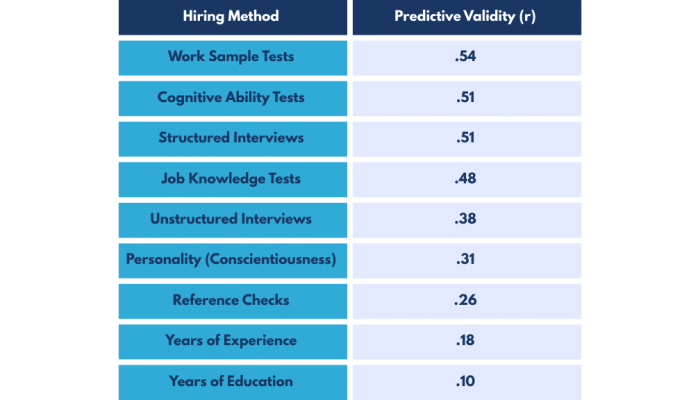
As you can see, structured interviews and cognitive assessments are among the most effective tools available to predict on-the-job performance. Resumes don’t even crack the top five.
Newer Research Confirms and Refines These Results
In 2022 and 2023, Sackett et al. revisited and updated this research using improved statistical techniques and broader data. Their findings?
- Structured interviews now outperform cognitive ability tests.
- Predictive validity scores were adjusted down by 0.10–0.20 due to better corrections.
- Unstructured interviews and years of experience are even less predictive than previously thought.
Updated Predictive Validities:
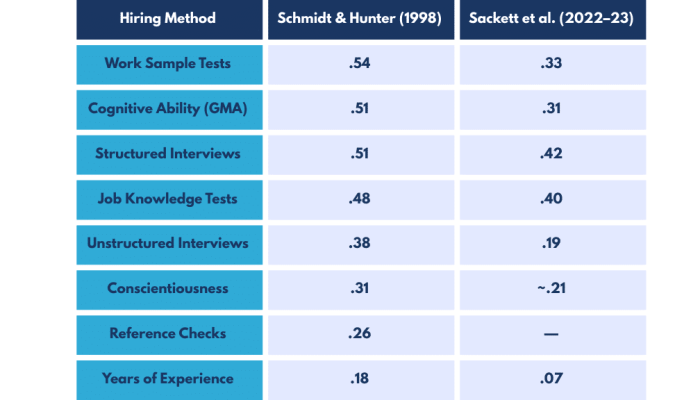
Structured interviews now hold the highest predictive validity. Combining them with assessments like cognitive ability and job knowledge tests offers the best results.
Even with updates, resumes, reference checks, years of experience and unstructured interviews remain among the least reliable predictors of job performance.
So, What Should You Do Instead?
Here’s what we recommend—and what we’ve seen consistently work in thousands of hires:
1. Use Assessments That Can’t Be Faked
We use and recommend the Talent Impact Profile™ (TIP), a tool that measures:
- Mental aptitudes (Cognitive Ability): mental acuity, problem-solving, vocabulary, and numerical accuracy
- Behavioral traits that align with long-term success
- A built-in “BS Meter” to catch exaggerated self-ratings
This aligns directly with both Schmidt and Hunter and Sackett’s updated research—cognitive ability and behavioral alignment remain top predictors of job performance.
“We recommend the Talent Impact Profile™ (TIP) for measuring cognitive ability as a complement to the Kolbe RightFit™ Hiring System. Together, they provide a powerful and well-rounded view of how a candidate thinks, acts, and solves problems instinctively.”
— Amy Bruske, President and Integrator, Kolbe Corp
2. Use Structured Interviews with Response Guides
Ditch the generic questions and resume walkthroughs. Instead:
- Ask behavior-based questions tied to the role and company culture
- Score responses against a structured guide
- Conduct live interviews (in-person or video, never via chat)
- Evaluate leadership traits when hiring managers and executives
This isn’t just best practice—it’s backed by decades of rigorous research.
“We’ve used the Talent Impact Profile™ along with our structured interviews to help our clients hire thousands of employees — and we’ve seen over 90% success in identifying top performers. It’s a proven tool that delivers results.”
— John Vidosh COO, VisionSparkSearch.com
3. Add Kolbe to Understand How They’ll Work
Once you know someone can do the job (aptitude) and how they like to work (motivation and fit), Kolbe helps you understand how they’ll take action in the job.
The Kolbe A™ Index measures conative strengths—how someone instinctively takes action. It reveals whether a person naturally:
- Initiates change or protects the status quo
- Brings focus and closure or thrives on interruptions
- Does in-depth research or focuses on the big picture
This insight helps match candidates not just to the role, but to your team’s operating style and your company’s pace.
"When it comes to hiring, one assessment rarely tells the full story. That’s why I recommend people use the Kolbe A™ Index as well as cognitive and personality profiles. The Talent Impact Profile™ does both — it reveals their cognitive abilities and behavioral tendencies while Kolbe shows how someone naturally takes action—their conative strengths. Together, they give a complete, holistic view of a candidate’s fit, especially in entrepreneurial companies where team alignment and execution are critical."
— Shannon Waller, Kolbe Certified™ Consultant and Strategic Coach® Teamwork Expert
If you're serious about hiring top talent—especially in leadership—stop putting so much trust in a document anyone can fake.
The science is clear:
Cognitive aptitude tests like the TIP™ predict success.
Structured interviews validate it.
Kolbe® reveals how they’ll get it done.
Resumes? Not even in the top five.
Data-driven hiring is the future.